

I left the Collaborative Gain Spring Council with a sticky note that won’t leave my brain:
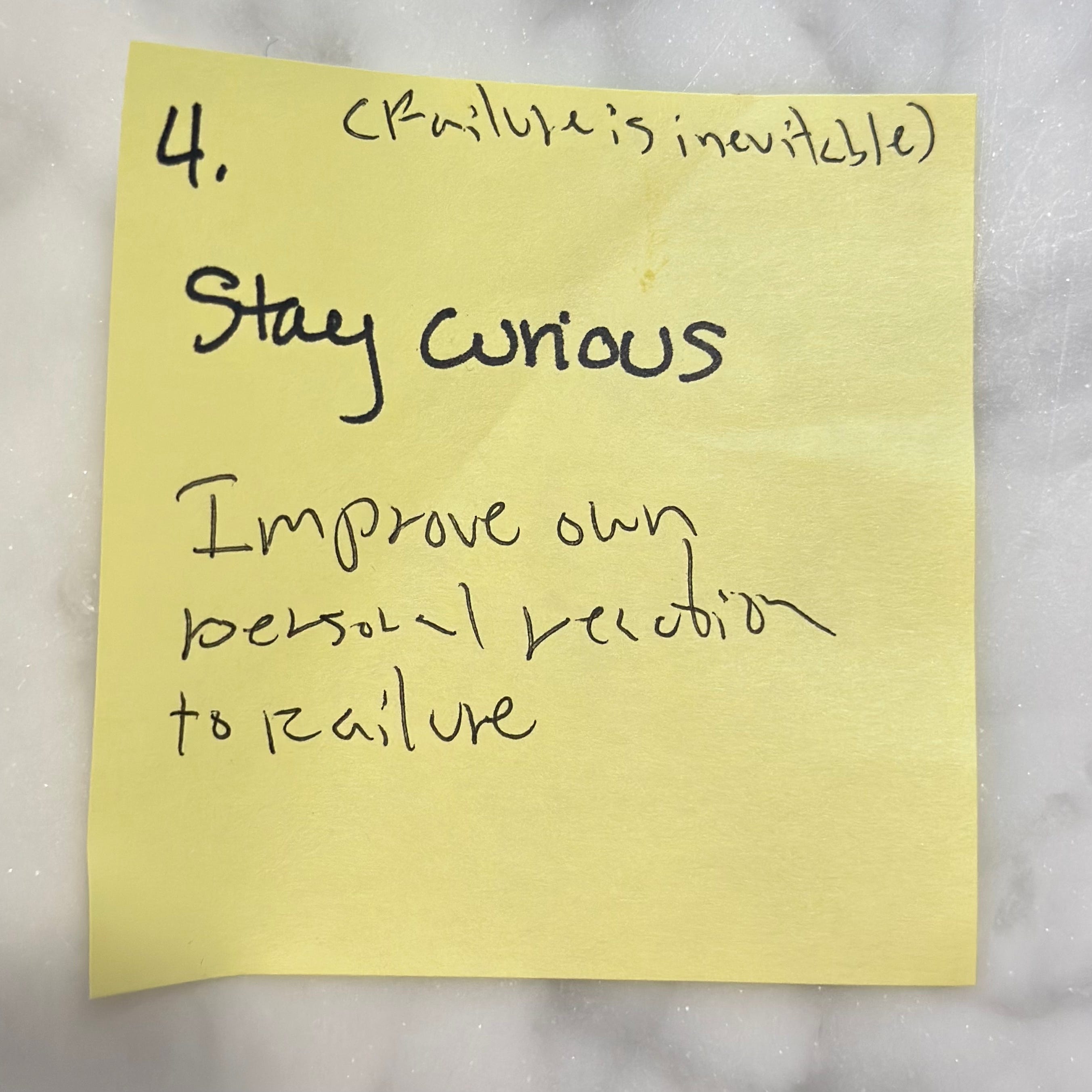
“Stay curious. Failure is inevitable. But we can improve our personal reaction to it.”
That note came out of an exercise on failing well. Intentionally, intelligently, and without shame. I’ve been turning it over in my head ever since. Not because it’s a clever soundbite, but because it cuts to the core of what leadership needs now.
I’ve spent the last two decades in tech. From networks to cybersecurity to increasingly abstract things like “AI” and “platform strategy.” Failure has always been part of the job, but lately, we’re swimming in it.
The stakes are high. The systems are bigger. The speed of change is off the charts. In that kind of environment, failure isn’t a detour, it’s the road.
And yet most teams (and most orgs) are still terrified of it. That fear shows its face as endless compliance theater, backchanneling, micro-management, or just plain silence. We pretend we’re fine. We fake alignment. And we wonder why our products fall flat.
So here’s the idea that stuck:
It’s not about avoiding failure. It’s about designing your response to it.
Amy Edmondson calls this intelligent failure: the kind you plan for, learn from, and emerge smarter because of. Marty Cagan (paraphrasing here) says that the real job of leadership is creating an environment where empowered teams can take smart risks. I’d add that only works if the culture gives people space to react to failure with curiosity instead of panic.
A Few Takeaways I’m Carrying Forward:
🔍 Measure outcomes, not output. What are you learning if you can’t connect your work to meaningful change?
🔁 Ritualize your learning. Make “What did we learn?” a habit that drives progress, not a post-mortem.
🧭 Know who’s helping you move toward the work that matters to you and your team.
🧠 Curiosity over control. Especially when things get messy.
These takeaways aren’t just about product teams. They’re about how we lead, build trust, and stay human in environments that constantly ask us to optimize, ship, and smile through the mess.
I don’t have it all figured out. But I do know I want to keep building with people willing to fail out loud, and get better, together.
If you’ve got a failure ritual that’s actually worked for your team, I’d love to hear it.